


Leather Sofa Repair in Singapore: Does Repair Still Make Sense—and What Leather Can Truly Be Restored?

Singapore is a fast city. We upgrade quickly, replace quickly, and move quickly. In that environment, it’s reasonable to ask whether leather sofa repair in Singapore still makes sense—or whether it’s simply easier to buy a new sofa and move on.
The answer is not a blanket yes or no. In practice, leather sofa repair is a value decision based on what you originally bought, what condition it is in, and what kind of leather it’s made from. The more important point—and the one many homeowners miss—is that not all “leather” behaves the same in repair.
Some leather can be reconditioned—restored to a richer sheen and a more premium hand feel without repainting the entire surface. Other leather cannot be truly restored because the surface you see is largely a synthetic finishing layer, not natural grain. For those, the usual option becomes respray with pigment/paint rather than genuine restoration.
This distinction matters because it determines:
-
what kind of repair result is possible,
-
what the cost-to-outcome ratio looks like,
-
and whether you should repair, recondition, reupholster, or replace.
This guide explains the economics of sofa repair in Singapore, when it makes sense, when it doesn’t, and how Locus Habitat approaches leather restoration—especially for full-grain leather.
Step 1: Does leather sofa repair still make sense in a fast-paced world?
Repair is not a moral decision. It is a practical one.
Leather sofa repair makes sense when at least one of these is true:
-
Financial value: Repair costs less than replacing at equivalent quality
-
Structural value: The sofa has “good bones” (frame and support system worth saving)
-
Material value: The leather is high-grade and worth preserving
-
Sentimental value: The sofa has meaning beyond price
-
Design value: The sofa fits your space perfectly and replacement introduces compromise
If none of these apply, replacement is often the smarter decision.
Step 2: The repair reality—labor dominates cost, not wood
A common misunderstanding is to assume the frame is the expensive part. In most sofas, the raw wooden frame materials are not the main cost driver. The major costs in both manufacturing and repair are typically:
-
upholstery labor
-
dismantling and reassembly time
-
foam and cushioning work
-
suspension repair (springs/webbing)
-
leather work and finishing
In repairs, labor becomes even more dominant because work often involves taking apart a product that was not designed to be taken apart. If you’re doing anything close to full reupholstery, the cost is largely paying skilled hands and time.
That is why the key repair question is:
Are you paying labor to rescue a sofa that deserves to be rescued?
Step 3: Types of leather sofa repair in Singapore (know what you’re actually asking for)
Not all repair is the same. The scope determines cost and feasibility.
1) Leather reconditioning (surface restoration)
This is the category many homeowners want—but don’t know how to ask for.
Reconditioning typically involves restoring the leather’s appearance and feel when the leather is:
-
dry
-
dull
-
lightly scuffed
-
losing its sheen
-
showing “tired” surfaces from daily contact
This is not the same as reupholstery. No dismantling. No replacing panels. It’s a surface and conditioning treatment.
2) Localized leather repair (minor damage)
This can include:
-
scratch repair
-
small scuff repair
-
localized color correction
-
minor surface crack treatment (depending on leather type)
3) Foam and cushion repair (comfort restoration)
Common for sagging seats and flattened cushions.
4) Suspension repair (springs/webbing)
Worth it mainly when the sofa was well-built to begin with.
5) Full reupholstery (the rebuild)
This is the most expensive option and only makes sense for sofas with significant underlying value.
The critical leather truth: not all “leather” can be restored the same way
This is the point that determines whether you can truly “restore back the shine the leather used to be.”
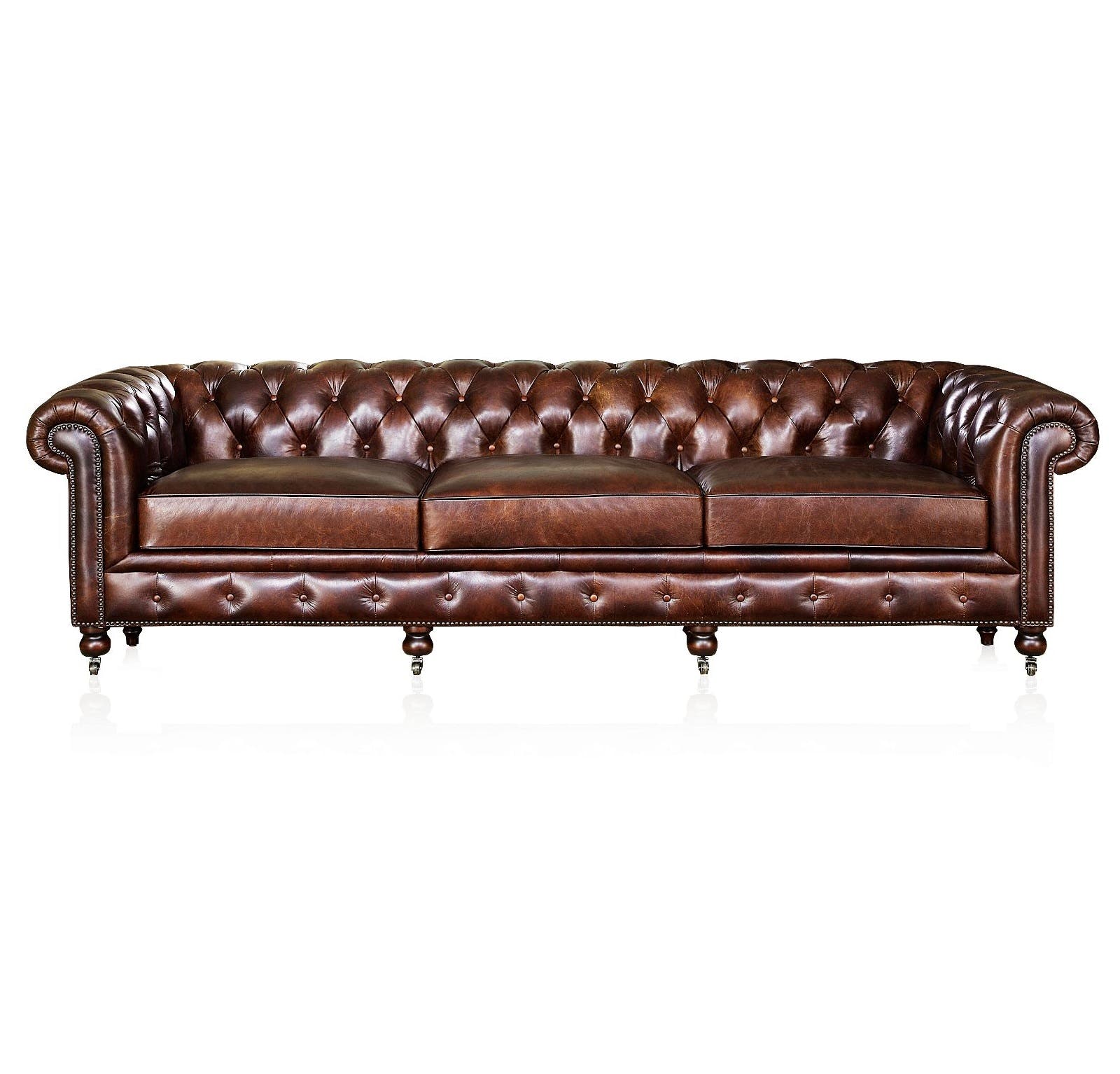
Full-grain leather: can often be reconditioned and restored (when not torn)
Full-grain leather retains natural grain and does not rely on heavy synthetic surface embossing to look uniform. When it becomes dull or dry, reconditioning can often restore richness and sheen—as long as the leather is not physically torn, broken, or structurally damaged.
In other words:
-
If the leather is intact (not torn), restoration is usually about hydration, surface renewal, and finishing.
-
The result can look and feel naturally revived rather than “painted.”
Embossed / heavily corrected leather: cannot be “truly restored” in the same way
Many mass-market “genuine leather” sofas use corrected leather with embossed grain and a synthetic topcoat.
In these cases, the visible surface is often dominated by the coating layer. Once that layer is worn, cracked, or dulled, true restoration is limited because you are no longer working with natural grain character.
The most common remedy becomes:
-
respray with pigment/paint to recolor and unify the surface.
This can improve appearance, but it is fundamentally different from full-grain reconditioning:
-
It is a cosmetic recoloring approach.
-
It does not recreate natural grain depth.
-
It may change the hand feel depending on products used.
Locus Habitat: leather repair and reconditioning (when it’s the right candidate)
At Locus Habitat, leather repair is approached with a practical, leather-first mindset:
1) Reconditioning to restore sheen—when leather is not torn or broken
If your leather sofa is full-grain and the leather is intact (no major tears, no structural breaks), Locus Habitat can recondition the leather to revive it—restoring the sheen and richness the leather used to have.
This is particularly suitable when the sofa looks:
-
dry or dull
-
aged unevenly on touch points (armrests, seat fronts, head areas)
-
lightly scuffed from daily use
-
visually tired but structurally fine
The objective is to bring the leather back to a healthier, more refined look—without turning it into a “painted” surface.
2) Clear limitation: embossed grain typically requires respray
If the sofa is upholstered in embossed grain / heavily coated leather, the surface is effectively a synthetic finishing layer. In that scenario, reconditioning cannot “recover” what is not there. The realistic pathway is usually:
-
respray with pigment/paint for cosmetic renewal.
This can still be worthwhile for the right sofa, but expectations must be set correctly: it’s surface recoloring, not natural-grain restoration.
3) Practical screening: repair vs rebuild decisions
Locus Habitat’s approach aligns with repair economics:
-
If the sofa is poorly constructed with low-quality springs and weak upholstery foundations, major repair may not make sense.
-
If the sofa has valuable leather and sound structure, repair and reconditioning can be a smart decision.
The question people avoid asking: does it make sense to reupholster a PVC sofa?
You asked this directly, and it is the right question.
If a sofa is upholstered in PVC/PU synthetic leather, full reupholstery often does not make financial sense unless:
-
the frame is unusually valuable,
-
the sofa has unique sizing you cannot replace,
-
or sentimental value outweighs economics.
Why? Because you are paying high labor to rebuild a product originally optimized for cost, not long-term repairability. In most cases, that budget would be better allocated toward a sofa with a stronger foundation and better upholstery material.
A decision framework: repair, recondition, repaint, reupholster—or replace?
Use this quick guide:
Choose reconditioning when:
-
leather is full-grain
-
leather is not torn or broken
-
the issue is dryness, dullness, scuffs, loss of sheen
-
you want restoration rather than a new cover
Choose respray when:
-
leather is embossed/corrected
-
surface coating is worn or color is uneven
-
you want cosmetic uniformity more than natural grain character
Choose foam/suspension repair when:
-
frame is solid
-
comfort has degraded (sagging, dips, squeaks)
-
leather is still acceptable or repairable
Choose full reupholstery when:
-
the sofa has strong structural and sentimental/design value
-
you want a full refresh and are prepared for labor-driven costs
Choose replacement when:
-
upholstery is PVC/PU and the problem is widespread
-
springs and structure are low quality
-
multiple systems are failing at once (foam + suspension + frame)
-
repair cost approaches replacement at better quality
Conclusion: repair still makes sense—but only when the leather can reward the effort
In a fast-paced world, leather sofa repair still makes sense in Singapore—but selectively.
If your sofa is upholstered in full-grain leather and the leather is intact, reconditioning can restore the sheen and richness in a way that feels authentic and satisfying. This is where specialist capability matters, and it is a service Locus Habitat is able to provide—reviving the leather rather than simply repainting it.
If your sofa is upholstered in embossed grain or heavily coated leather, true restoration is limited. The realistic solution is often respray with pigment/paint, because the surface is fundamentally a synthetic finishing layer.
And if the sofa is fundamentally a low-quality build—weak springs, basic upholstery foundation, PVC upholstery—full reupholstery often does not make economic sense.
The smartest approach is to match the repair method to the leather type and the sofa’s underlying value. Done correctly, repair is not old-fashioned—it is a disciplined decision that preserves what is worth preserving and avoids paying skilled labor to rescue what was never built to last.